Our history
The congregation is older than the building and older than the name: founded in 1821, the year after Maine itself became a state. Here is how it got from a wooden church downtown to a low brick building under a hundred-foot tree on Allen Avenue.
Two centuries, in brief
- 1821Founded as the First Universalist Society of Portland, with a wooden church at Congress and Pearl and an installation sermon by Hosea Ballou.
- 1961The Universalist Church of America and the American Unitarian Association merge to form the Unitarian Universalist Association.
- 1971The Allen Avenue building is dedicated; a dawn redwood is planted at the door.
- 1976Tirrell Kimball begins as the first professional Director of Religious Education, a post she holds until 2003.
- 1980The congregation takes the name it answers to now: the Allen Avenue Unitarian Universalist Church.
- 1984The Children’s Memorial Fund is established, sending children to Unitarian Universalist summer camps.
- 1991The building is enlarged for a religious-education program that had outgrown its space.
- 1993The congregation declares itself a Green Sanctuary.
- 2003Recognized by the UUA as an LGBTQ Welcoming Congregation.
- 2005The Rev. Dr. Myke Johnson is called as Settled Minister, a ministry of thirteen years.
- 2013Helps form the Maine UU State Advocacy Network.
- 2022The Rev. Tara Humphries begins as Developmental Minister.
- 2025The road sign is repainted in the colors of the Progress Pride flag.
Beginnings
In 1821, a group of people in Portland set out to build a place for liberal religion. They formed the First Universalist Society of Portland and put up a wooden church at the corner of Congress and Pearl Streets. The installation sermon was preached by Rev. Hosea Ballou, sometimes called the father of Universalism.
In 1865, the congregation built a new building with seating for 1,100 people, and renamed itself The First Universalist Church. Because of its location at Congress and High Streets, it was called the “Congress Square” church. Alongside it were the India Street Universalist Society and the Church of the Messiah, serving the Munjoy Hill neighborhood.
In 1829, other Universalists had founded the First Universalist Society of Westbrook. In 1867 they built the New Universalist Church on Stevens Avenue at the Westbrook Seminary (later Westbrook Junior College); the former church is now the University of New England’s Ludcke Auditorium.
As the neighborhood was incorporated into Portland, that church went through other name changes: All Souls Church in 1883, and All Souls Universalist Church in 1927. In 1943, the Church of the Messiah and All Souls Universalist Church merged, renovated the building on Stevens Avenue, and took the name Messiah-All Souls Universalist Church. First Universalist (Congress Square) sold its building and merged with Messiah-All Souls in 1964, and the combined congregation renamed itself the Universalist Church of Portland.
In 1961, the two traditions that the congregation now carries came together nationally: the Universalist Church of America and the American Unitarian Association merged to form the Unitarian Universalist Association. That merger, as the church puts it, enlarged our religious tradition.
A home on Allen Avenue
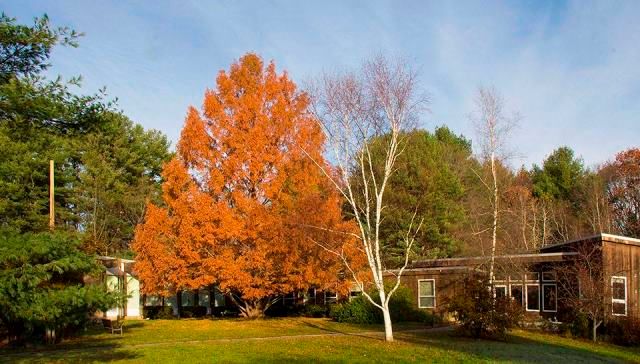
The current building was dedicated in 1971. It is low and all on one level, a practical New England building rather than a grand one. The year it opened, someone planted a dawn redwood as a seedling in the front garden. It is still there, and it now stands close to a hundred feet tall.
The dawn redwood is worth a word. For a long time it was known only as a fossil and assumed extinct, until living trees were found in China in the 1940s and seeds were shared around the world. Planting one in 1971 was a small act of optimism. It has paid off.
The building grew once. In 1991, the congregation expanded it to make room for a religious-education program that had outgrown its space. More on that below.
Becoming A2U2
For most of its life the congregation went by some version of its founding name. In 1980 it settled on the one it uses now: the Allen Avenue Unitarian Universalist Church. The street it sits on became the name it answers to. The nickname A2U2 followed from there.
Generations of learning
From 1976 to 2003, Tirrell Kimball served as the congregation’s first professional Director of Religious Education. Under her the program grew past a hundred children, enough that the building had to be enlarged in 1991 to hold them. She received the Angus MacLean Award in 2003, named Director of Religious Education Emerita in 2010, and remembered by the congregation when she died in July 2025.
In 1984, Kathie and Peter Stead established the Children’s Memorial Fund in memory of their son Jeffrey. It pays for scholarships so children can go to Unitarian Universalist summer camp.
The work continues. Religious education at A2U2 still runs most Sundays through the school year, for children and youth, with grown-ups learning alongside them in small groups.
Our ministers
The congregation has had many ministers across two centuries, beginning with Rev. Russell Streeter in 1821. Other early ministers included Rev. Earl McKinney and Rev. Robert Wolf. From the late ’80s through the early ’00s we were served by Rev. Tom Yondorf and Rev. Jean Wahlstrom, the congregation’s first female minister.
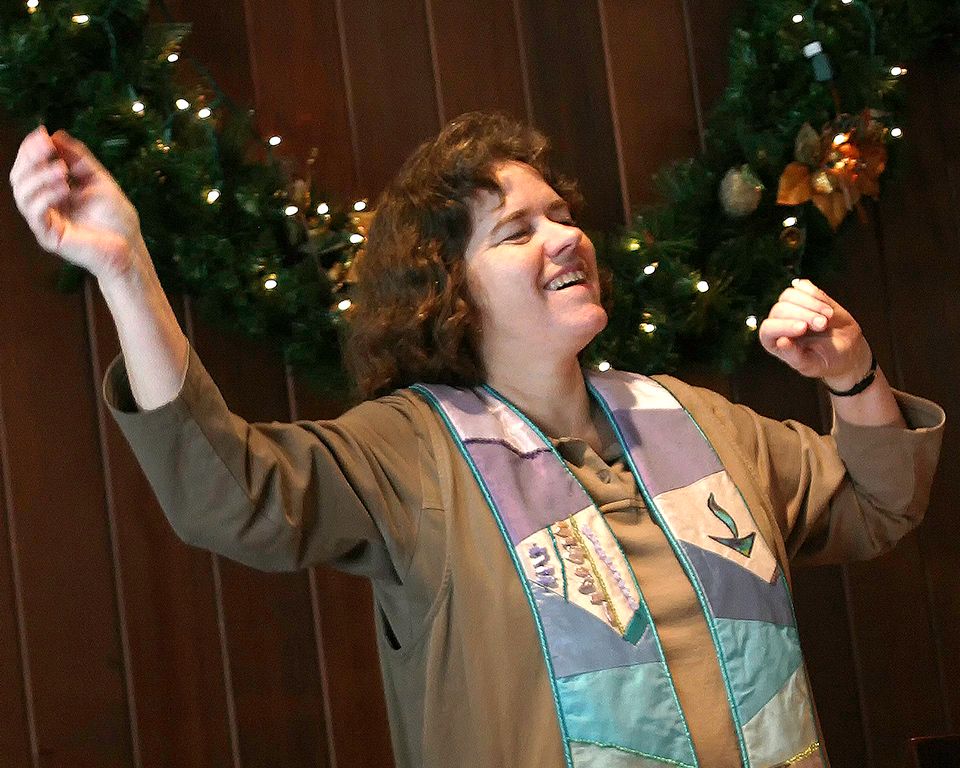
From 2005 to 2018, the Rev. Dr. Myke Johnson served as Settled Minister, thirteen years in all. During her ministry the congregation added a second Sunday service, adopted a new mission statement in May 2006, started a lay pastoral-care team and a leadership-development program, and worked on marriage equality in Maine in 2008 and 2012. She was named Minister Emerit in 2018. She still lives in Portland with her partner Margy; they are cherished members of our A2U2 community.
After an interim period with the Rev. Anita Farber-Robinson and a short COVID-19 ministry with the Rev. Donna Dolham, the Rev. Tara Humphries (they/them) served as A2U2’s Transitional Minister from 2022 to 2024. In 2024, the Board of Trustees voted unanimously to extend Rev. Tara’s ministry with us for a five-to-seven-year developmental period, to help guide us into a new shared ministry centered on healthy communication and systems, inclusivity, trust, and deep joy. Rev. Tara now serves as our Developmental Minister. You can read more about them on the About page.
A habit of showing up
Justice work is not a recent enthusiasm here; it is a long habit. The congregation declared itself a Green Sanctuary in 1993, committing to environmental responsibility, and became a Welcoming Congregation in 2003, the Unitarian Universalist Association’s recognition for explicit, practiced work on LGBTQ+ inclusion. In the years between and since, members sponsored refugee families, helped defeat a 2005 referendum that would have stripped rights from gay, lesbian, and transgender people in Maine, raised tens of thousands of dollars for the Four Directions Development Corporation, and helped form the Maine UU State Advocacy Network in 2013. Awards came along the way, though the work was never for the awards.
That is the short version. The fuller account is on the justice page, decade by decade.
Where we are now
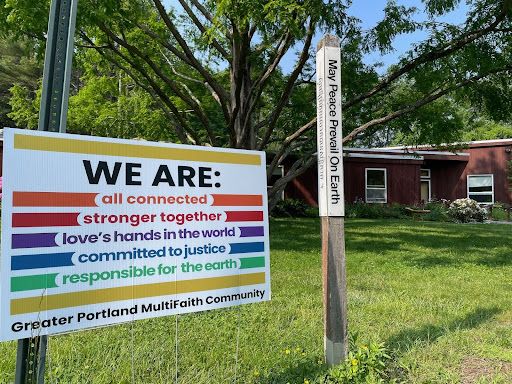
In 2025, the road sign out front was repainted in the colors of the Progress Pride flag by the local muralist Chel. It says at the curb what the congregation has spent decades saying inside.
Two hundred years on, the work is recognizable. A congregation gathers, asks hard questions, looks after one another, and tries to be useful to the city around it. The tree keeps growing.
Come see the place for yourself. Plan a visit, or read more about who we are today.